
Owner-Operator Trucking Business Guide
Driving a truck is a skilled trade; running a trucking business is a capital-intensive logistics enterprise. The difference between gross settlement checks and true take-home pay is determined by your fixed cost dilution, all-in deadhead rate math, preventative maintenance escrow, and quarterly tax reserves. This flagship guide organizes the five foundational pillars every owner-operator must master to build a durable, solvent business.
First check
Running a solvent owner-operator business requires mastering five operational pillars: (1) Capitalization: Maintain at least $15,000 to $25,000 in liquid working capital before launch; (2) Cost Floor: Audit your all-mile operating floor ($2.10–$2.50/mi based on ATRI national data); (3) All-In Pricing: Factor empty origin and repositioning deadhead into every rate before booking; (4) Escrow Discipline: Dedicate 15–20¢/mile to major component reserves and reserve 25%–30% of net settlement for quarterly taxes; and (5) Compliance: Maintain clean DQF, IFTA, Clearinghouse, and ELD records from day one.
Driver Compensation Floor
The single largest cost. Hauling under operating cost plus driver pay means working for free.
Dual Saddle Fuel Tanks & DEF
15,385 gallons burned annually. A 0.5 MPG loss drains $4,200 straight from net cash flow.
Sleeper Cab Chassis & Debt Note
A relentless $2,916/month debt clock that never pauses when freight softens or weather strikes.
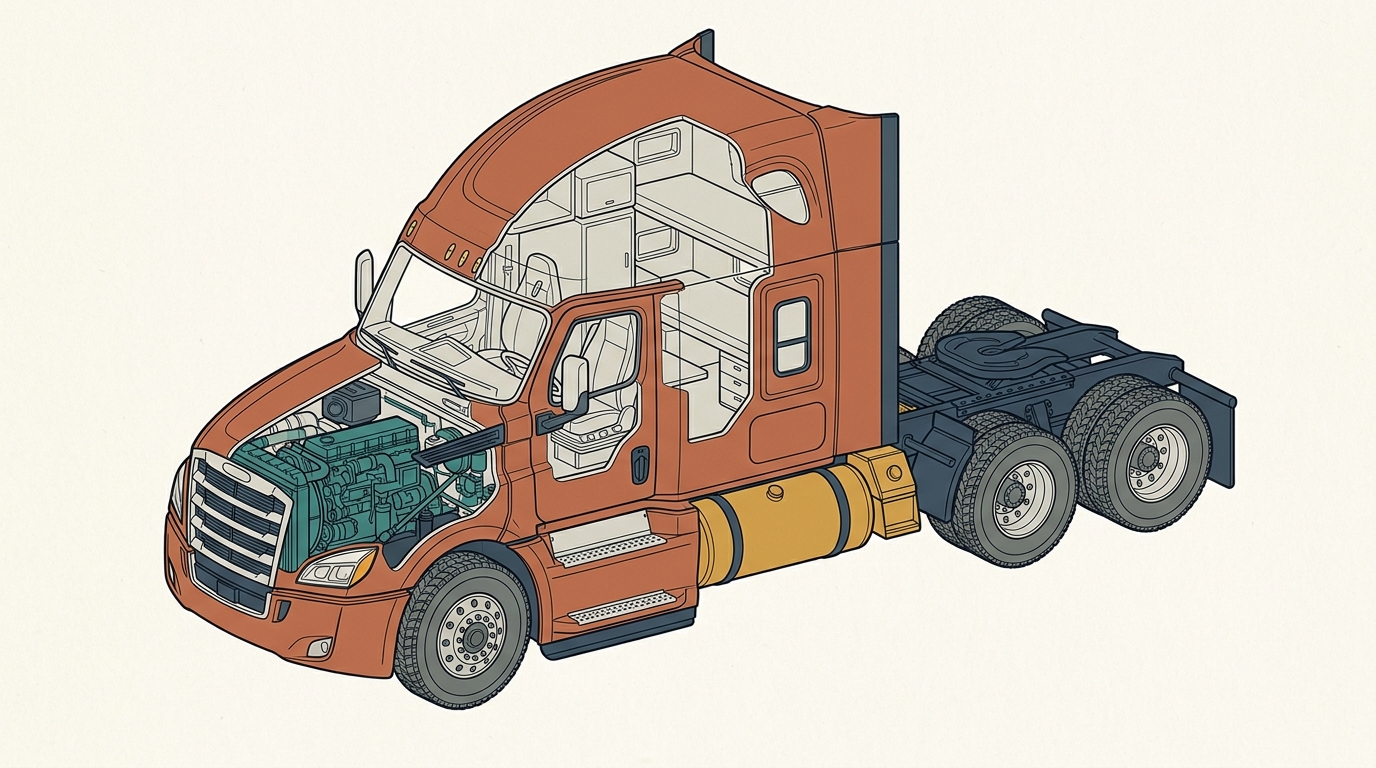
Powertrain & Overhaul Escrow
At $32,000 per engine rebuild, carriers without dedicated escrow fail on their first head gasket.
Regulatory Overhead & Insurance
Commercial liability, ELD subscriptions, IRP plates, and federal compliance mandates.
18-Wheel Tire Tread Lifecycle
10 PSI under-inflation burns 1% extra fuel and destroys tire casings for future retreading.
Driver Compensation Floor
Ongoing weekly owner draw / payroll
Never bid below your personal W-2 wage equivalent. If a load pays less than operating expenses plus $0.78/mi, you are donating your driving labor for free while bearing 100% of the equipment risk.
Complete Class 8 Operating Cost Distribution (ATRI Baseline)
| Expense Category | Classification | Cost / Mile | Annualized (100k mi) | Cost Share | Operating Vulnerability |
|---|---|---|---|---|---|
| Driver Compensation Floor | Driver Pay | $0.78/mi | $78,000 | 33.3% | Ongoing weekly owner draw / payroll |
| Dual Saddle Fuel Tanks & DEF | Fuel & Fluids | $0.55/mi | $55,000 | 23.5% | 15,385 gallons / 100k miles (6.5 MPG baseline) |
| Sleeper Cab Chassis & Debt Note | Equipment Financing | $0.35/mi | $35,000 | 15% | $2,200 – $2,900 / month commercial equipment debt |
| Powertrain & Overhaul Escrow | Maintenance | $0.20/mi | $20,000 | 8.5% | PM every 25,000 mi · In-frame engine rebuild at 600k mi ($28k–$36k) |
| Regulatory Overhead & Insurance | Fixed Overhead | $0.41/mi | $41,000 | 17.5% | ELD monthly subscription + Annual Auto Liability renewal ($14k+) |
| 18-Wheel Tire Tread Lifecycle | Tires | $0.05/mi | $5,000 | 2.1% | Steers: 100k mi · Drives: 250k–350k mi · Trailer: 200k mi |
| TOTAL OPERATING BASELINE FLOOR | $2.34/mi | $234,000 | 100.0% | Minimum survival floor before business net profit | |
Core Operating Findings
National Cost Floor
ATRI average marginal carrier operating cost across combined linehaul and regional operations ($1.85/mi non-fuel baseline).
Median Net Take-Home
ATBS independent contractor benchmark after equipment debt, diesel fuel, and preventative maintenance reserves.
Minimum Cash Reserve
Recommended liquid working capital needed to survive initial 45-day broker invoice lag and early repair events.
Unpaid Deadhead Drag
Average solo OTR empty repositioning miles that erode headline gross linehaul and billable revenue.
Owner-operator solvency benchmarks: gross revenue vs. real net profit
According to ATRI and ATBS independent contractor studies, gross settlement checks obscure the 65% to 75% expense ratio required to operate a Class 8 commercial tractor.
Average Gross Revenue
Typical annual gross linehaul for solo owner-operators running 100,000 highway miles.
Operating Expenses
Direct out-of-pocket costs for diesel ($55k), equipment debt ($35k), PM ($20k), and insurance ($11k).
Net Take-Home Pay
Pre-tax net cash income before federal and state personal income taxes.
A one-truck operation must price freight to fund fixed debt, variable fuel, overhaul escrow, and living wages. Miles without margin simply consume equipment equity.
The 1-Truck Business Solvency Checklist & Capital Requirements
| Operating Component | Startup / Monthly Cost | Key Risk to Mitigate | Essential Best Practice |
|---|---|---|---|
| Working Capital Reserve | $15,000 - $25,000 cash | 30–45 day broker payment lag | Never burn reserve capital for initial equipment down payments |
| Tractor Debt / Financing | $1,800 - $3,000 / month | High-interest equipment note eating cash | Cap equipment financing at 15%–18% of projected monthly gross revenue |
| Primary Auto Liability Insurance | $1,000 - $1,800 / month | New authority rate surcharges | Maintain clean CDL MVR and complete pre-quote filing checks |
| Fuel & Operating Cash | $4,500 - $6,000 / month | Spiking diesel pump prices | Use a cost-plus fuel card with verified in-network corridor stops |
| Preventative Maintenance Escrow | $1,500 - $2,000 / month (15–20¢/mi) | Catastrophic in-frame engine overhaul | Deposit maintenance cents into a segregated, untouchable savings account |
| Quarterly Tax Reserves | 25% - 30% of net settlement | IRS Form 2210 underpayment penalty | Pay quarterly estimated taxes on Form 1040-ES on statutory dates |
Based on ATRI marginal cost research and small carrier operational finance models. Assumptions reflect 8,500 to 10,000 monthly solo miles.
The 5-Phase Owner-Operator Launch Sequence
Launching an owner-operator business requires moving methodically through capitalization, equipment acquisition, operating structure, freight channels, and compliance systems. Rushing into equipment purchases before establishing a legal entity, business checking, and cash reserves is the primary cause of early authority failure. Follow our sequential milestone roadmap to ensure every legal and financial requirement is satisfied before hauling your first load.
- Phase 1: Working Capital & Entity Formation: Form a limited liability company (LLC), secure an Employer Identification Number (EIN) from the IRS, open a dedicated commercial checking account, and deposit at least $15,000 to $25,000 in unencumbered operating cash reserves.
- Phase 2: Operating Authority & BOC-3 Filings: Apply for USDOT and MC numbers with the FMCSA, file Form BOC-3 designating legal process agents in all 48 contiguous states, and register under the Unified Carrier Registration (UCR) agreement.
- Phase 3: Commercial Insurance & State Licensing: Secure primary auto liability ($1M), physical damage, and cargo ($100k) policies; register apportioned cab cards under the International Registration Plan (IRP) and establish your International Fuel Tax Agreement (IFTA) account.
- Phase 4: Equipment Acquisition & Pre-Trip Vetting: Source a road-ready Class 8 tractor through cash purchase or conservative commercial bank financing with a mandatory ECM readout, dyno test, and fluid analysis; install an FMCSA-registered ELD.
- Phase 5: Freight Network & Settlement Workflow: Subscribe to primary spot load boards, execute broker carrier packets, set up fuel card accounts with cost-plus discounts, and establish an automated 24-hour invoicing workflow.
Operating Authority (USDOT/MC) vs. Carrier Lease-On: True Net Margin & Risk Allocation
Choosing between operating under your own independent motor carrier authority and leasing on to an established carrier is the fundamental strategic fork in your trucking career. Both business models can be profitable, but they distribute financial risk, administrative burden, and overhead costs in fundamentally different ways.
- Independent Authority Margins: You retain 100% of gross linehaul, negotiate directly with freight brokers and shippers, and build brand equity in your company name. However, you absorb 100% of business overhead: $12,000 to $20,000 in first-year commercial insurance premiums, software subscriptions, state permits, compliance audits, and all broker credit default risk.
- Carrier Lease-On Margins: You contract your equipment to an established motor carrier in exchange for 65% to 85% of gross linehaul revenue (or a flat per-mile rate). You operate under the carrier’s USDOT/MC authority, accessing fleet-discounted commercial insurance ($4,000–$8,000/yr), institutional fuel discounts, electronic toll transponders, and company dispatch support.
- The Financial Tipping Point: If you run 100,000 annual miles grossing $2.40/mile ($240,000 gross), an 80% lease-on yields $192,000 before operating expenses, saving roughly $10,000 in insurance and administrative fees. For new operators without established customer networks, a 1-to-2 year lease-on provides cash-flow stability and operational experience before taking on the fixed overhead of independent authority.
Equipment Acquisition Due Diligence: Pre-Purchase Dyno, Oil Sampling & ECM Readouts
Your truck is not just a vehicle; it is a revenue-generating power plant. Purchasing an unreliable commercial tractor with hidden mechanical defects is the fastest route to bankruptcy. Perform comprehensive mechanical due diligence before signing a purchase agreement or wiring down payment funds.
- Electronic Control Module (ECM) Audit: Have a certified master technician connect diagnostic software to pull the complete ECM engine history: lifetime fuel average (target 6.5+ MPG), lifetime idle time percentage (below 20% is ideal), active and historic fault codes, and maximum recorded road and engine speed over-rev events.
- Crankcase Blowby & Dynamometer Testing: Measure crankcase blowby pressure with a water manometer to verify piston ring seal integrity. Conduct a chassis dynamometer test under full engine load to measure actual rear-wheel horsepower and verify turbo boost pressure against factory specifications.
- 10-Point Fluid Spectrochemical Analysis: Draw engine oil, transmission fluid, and differential fluid samples for laboratory testing before purchase. The report detects microscopic traces of coolant (glycol), fuel dilution, soot percentage, and wear metals (iron, copper, lead, aluminum) signaling imminent bearing or cylinder liner failure.
- DOT Annual Inspection & Maintenance Records: Demand full maintenance records proving regular oil changes, DPF cleanings, and overhead valve lash adjustments. Verify the tractor has a fresh DOT annual inspection decal and inspect frame rails for rust scaling or structural cracks.
Permits, Filings & Regulatory Compliance: USDOT, MC, BOC-3, UCR, IRP & IFTA
Operating an interstate trucking business requires navigating a complex web of federal and state regulatory requirements. Falling behind on compliance filings can lead to administrative authority revocation, roadside out-of-service orders, or severe financial penalties during your New Entrant safety audit.
- FMCSA New Entrant Safety Assurance Program: New motor carriers are placed in an 18-month safety monitoring period. You must pass a comprehensive New Entrant Safety Audit within 12 months, proving compliant Driver Qualification Files (DQF), maintenance logs, pre-employment drug screening, and ELD compliance.
- Form 2290 Heavy Highway Vehicle Use Tax (HVUT): Federal tax filed annually with the IRS for commercial motor vehicles operating at 55,000 lbs gross weight or higher. You must provide a stamped IRS Schedule 1 receipt to renew state IRP apportioned license plates.
- Unified Carrier Registration (UCR): Annual mandatory fee paid to your base state under the federal UCR agreement based on total fleet size (Tier 1 for 0–2 commercial vehicles).
- FMCSA Drug & Alcohol Clearinghouse & Consortium: Single-truck owner-operators are legally classified as employers under 49 CFR Part 382 and must designate a Third-Party Administrator (C/TPA) consortium for mandatory random drug and alcohol testing pools.
Separating Motion from Margin: Why Loaded Miles Do Not Guarantee Cash
A semi truck running 3,000 miles a week at $2.10/mile burns cash faster than a truck parked in a yard if its true cost per mile is $2.25. Every operating mile incurs direct variable costs: diesel fuel, tire casing wear, engine oil degradation, and component depreciation. Knowing your break-even floor empowers you to decline freight that fails to cover variable costs and overhead contribution.
- The Cash-Bleed Math: A semi tractor running 2,500 miles a week at $2.05/mile generates $5,125 in gross revenue. If all-in operating costs are $2.20/mile, that truck burns $375 of cash reserves every week. Operating empty miles without margin accelerates vehicle depreciation while consuming finite driver hours of service.
- The Deadhead Factor: Origin deadhead (empty miles to the shipper) and destination deadhead (empty miles to the next load) must be factored into every rate calculation. An 800-mile run paying $2,000 ($2.50/loaded mile) that requires 200 miles of deadhead is actually a 1,000-mile trip paying $2.00 all-in. Never evaluate freight on loaded miles alone.
- The Spot Rate Floor: Establish a non-negotiable walkaway rate floor based on your audited monthly cost per mile plus a 15% minimum operating margin. Declining unprofitable freight preserves your equipment and capital for loads that generate genuine business profit.
The Maintenance Escrow Discipline: Surviving Major Component Failures
An in-frame engine overhaul costs between $20,000 and $35,000; a single roadside tire service call costs $600 to $1,200. Successful owner-operators treat maintenance as a non-negotiable per-mile operational expense, escrowing at least 15 to 20 cents per odometer mile into a dedicated, segregated business savings account. Without this reserve, one unexpected tow or transmission failure triggers immediate business insolvency.
- The Per-Mile Maintenance Reserve: Deposit a non-negotiable 15 to 20 cents per odometer mile into a segregated, high-yield business savings account every week. For an operator running 2,000 miles a week, this deposits $300 to $400 weekly ($15,000–$20,000 annually) exclusively for mechanical maintenance.
- Component Overhaul Benchmarks: Modern Class 8 engine in-frame overhauls (pistons, cylinder liners, rod/main bearings, cylinder head) cost between $25,000 and $35,000. Remanufactured automated manual transmissions cost $9,000 to $13,000, and a full set of 8 drive tires costs $4,000 to $5,500.
- Preventative Maintenance Routines: Perform complete engine oil, fuel filter, and lube service every 15,000 to 20,000 miles. Perform oil sampling at every change to monitor engine wear trends before catastrophic mechanical failure occurs.
Freight Sourcing Strategy: Load Boards, Direct Shippers & Dedicated Corridors
A durable freight sourcing strategy evolves over time. While new motor carriers rely on public spot load boards to generate initial cash flow, surviving market downturns requires building a diversified portfolio of direct shipper relationships and regional contract lanes.
- The Spot Market Load Board Foundation: Utilize DAT One and Truckstop as initial load-sourcing engines during your first 6 months of operation. Focus on building consistency within 2 or 3 regional corridors rather than running haphazardly across all 48 states.
- Transitioning to Direct Shipper Freight: Identify local manufacturers, agricultural packing sheds, and distribution facilities within your home market. Pitch direct freight solutions highlighting your reliable on-time delivery, modern equipment, and dedicated communication.
- Developing Triangular Lanes: Never book an out-and-back lane where the return freight pays below your cost per mile. Develop three-legged triangular routes (e.g., Atlanta -> Chicago -> Columbus -> Atlanta) to ensure every leg pays profitable freight.
Quarterly Tax Discipline: S-Corp Structuring, Schedule C & Per Diem Deductions
Tax mismanagement destroys more trucking companies than mechanical breakdowns. Operating as a 1099 independent contractor or LLC owner-operator means income taxes are not withheld from your settlements, leaving you solely responsible for federal and state payroll and income taxes.
- The 15.3% Self-Employment Tax (SECA): Sole proprietors and single-member LLCs pay 15.3% in FICA payroll taxes on net business profit. For an operator netting $80,000, this represents $11,304 in payroll taxes before federal and state income taxes are assessed.
- The S-Corporation Election Strategy: Electing S-Corp taxation (IRS Form 2553) allows an operator to designate a reasonable W-2 salary (e.g., $50,000) and take remaining net profits (e.g., $30,000) as business dividend distributions, saving thousands of dollars in self-employment taxes.
- The Transportation Per Diem Allowance: Under IRS Notice 2025-54, transportation workers subject to FMCSA HOS rules can claim the special daily per diem ($80/day in CONUS at an 80% deductible allowance = $64/day deduction) for nights away from home without retaining restaurant or grocery receipts.
A note for visitors following older links
This URL is linked from 2017 coverage of the former Blue Bloodhound driver marketplace. That service and its accounts no longer operate here. The current page is an owner-operator business guide; the preserved history pages document the former company.
How to decide
Phase 1: Capitalization & Legal Entity
Establish an LLC, obtain an EIN, set up a dedicated commercial checking account, and secure at least $15,000 to $25,000 in unencumbered operating cash reserves before acquiring equipment.
Phase 2: Equipment Sourcing & Due Diligence
Acquire a road-ready Class 8 tractor through conservative financing; obtain an independent ECM dyno report, oil sample analysis, and fresh DOT annual inspection decals.
Phase 3: Operating Authority vs. Carrier Lease-On
Decide whether to obtain independent USDOT/MC authority (higher autonomy, $12k–$20k first-year insurance) or lease on to an established carrier (65%–85% revenue share, fleet insurance, dispatch support).
Phase 4: Rate Floor & Freight Sourcing Strategy
Calculate your exact break-even rate per mile including 15% deadhead. Subscribe to DAT One or Truckstop and establish direct relationships with credit-verified freight brokerages.
Phase 5: Cash Conversion & Compliance Calendar
Submit clean bills of lading and rate confirmations within 24 hours of delivery. Reconcile fuel receipts for quarterly IFTA, and log ELD per diem nights for federal tax substantiation.
First-Year Solo Owner-Operator Annual Financial Model (100,000 Miles)
A solo owner-operator running dry van freight under their own authority, averaging 100,000 total highway miles (85,000 loaded miles + 15,000 deadhead miles) at an average loaded rate of $2.75/mile.
- 1. Gross Linehaul Revenue85,000 loaded miles × $2.75/mi = $233,750 gross revenue ($2.337 all-in RPM across 100k total miles).
- 2. Diesel Fuel & DEF Expense100,000 miles ÷ 6.5 MPG = 15,385 gallons × $3.85 net delivered diesel = $59,232 ($0.592/mi).
- 3. Equipment Financing Note$2,500/month tractor payment + $600/month trailer note = $37,200 annually ($0.372/mi).
- 4. Commercial Truck InsurancePrimary liability ($1M), physical damage, cargo ($100k) = $16,500 annually ($0.165/mi).
- 5. Maintenance & Tire Escrow100,000 miles × $0.20/mile maintenance reserve + $0.05/mile tire wear = $25,000 ($0.250/mi).
- 6. Back-Office, Subscriptions & PermitsELD, DAT One, accounting, IFTA, UCR, Form 2290, banking/factoring = $9,500 annually ($0.095/mi).
- 7. Total Operating Expenses$59,232 + $37,200 + $16,500 + $25,000 + $9,500 = $147,432 total operating cost ($1.474/mi non-labor cost).
- 8. Net Pre-Tax Income to Owner$233,750 gross revenue − $147,432 operating bills = $86,318 net Schedule C earnings ($0.863/mi compensation).
Sources
ATRI: Operational Costs of TruckingComprehensive industry-wide benchmarks for marginal carrier operating costs per mile. Retrieved August 2026.↗ATBS: Independent Contractor Benchmark ReportVerified owner-operator net take-home earnings and operational expense ratios.↗FMCSA: Motor Carrier Safety Assurance ProgramFederal requirements for new entrant motor carrier safety audits and compliance deadlines.↗IRS Notice 2025-54: Transportation Per Diem RatesStatutory meal and incidental expense per diem deduction rules for commercial transportation workers.↗Frequently asked questions
How much money do I need to start an owner-operator business?
Most successful owner-operators start with at least $20,000 to $35,000 in total capital: $10,000 to $15,000 for equipment down payments and initial insurance deposits, plus an essential $15,000 to $20,000 in unencumbered liquid cash reserves to fund fuel, tolls, and living expenses during the initial 30 to 45 days before broker settlements clear.
Is it better to lease on to a carrier or get my own authority?
Leasing on provides immediate access to carrier freight, lower fleet insurance rates, fuel card discounts, and reduced back-office administration in exchange for a 15% to 35% revenue split. Operating under your own authority offers 100% freight autonomy and direct customer billing, but requires managing all insurance filings, safety audits, and broker credit risk.
What is a realistic net income for an owner-operator in 2026?
According to ATBS independent contractor financial data, a disciplined solo owner-operator grossing between $220,000 and $260,000 typically nets between $65,000 and $88,000 in pre-tax take-home earnings after deducting all operating costs (fuel, financing, insurance, maintenance reserves, and permits).
What is the biggest mistake new owner-operators make?
The single most catastrophic mistake is evaluating freight using headline loaded rate per mile while ignoring empty origin and repositioning deadhead miles. Empty miles consume fuel and equipment life without generating revenue, rapidly eroding profit margins.
Related pages
Find better freight
Understand load boards, broker relationships, and lane research.
Price every mile
Turn fixed and variable costs into a working cost per mile.
Protect cash flow
Compare the real tradeoffs behind faster invoice payment.
Stay road-ready
Build a practical ELD, tax, insurance, and recordkeeping routine.
Reduce fuel drag
Evaluate discounts, fees, acceptance, and controls.
Keep clean books
Organize expenses, IFTA inputs, and business reporting.
Looking for the former Blue Bloodhound?
Read the history of the former driver marketplace and the ownership transition.